

BLOG
How Much Weight Can a Floating Vanity Countertop Support Without Brackets?
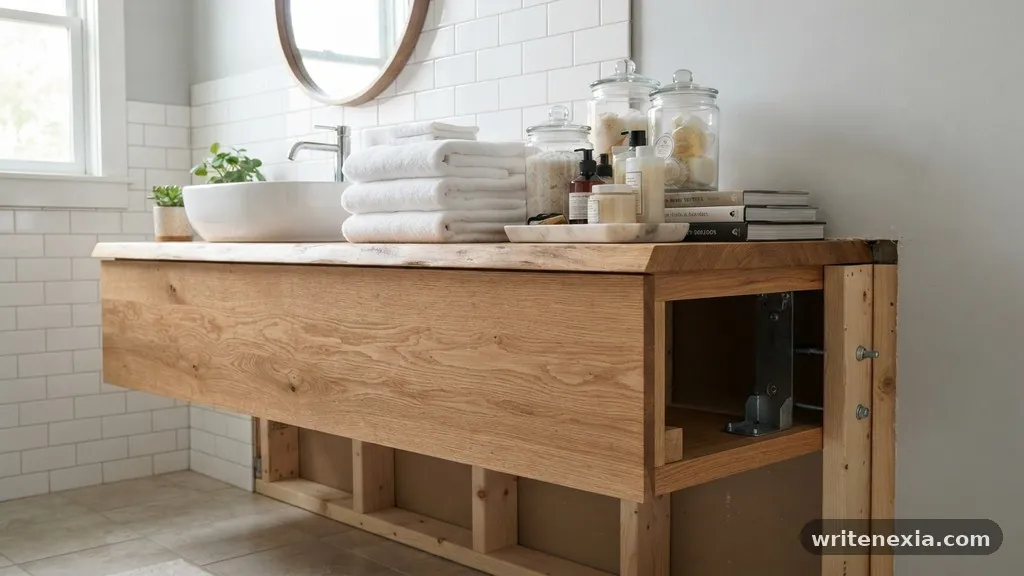
Determining how much weight can a floating vanity countertop support without brackets is a critical calculation for any bathroom renovation project. While the aesthetic appeal of a wall-mounted unit lies in its minimalist, gravity-defying appearance, homeowners often worry about the structural integrity of the countertop itself. Without visible support hardware, you are essentially relying on the mechanical connection between the cabinetry and the wall studs to distribute the load.
Understanding the material limitations, wall construction, and the physics of cantilevered surfaces is essential before you begin your installation. In this article, we will examine the actual load-bearing capacities of various materials and the risks associated with mounting heavy countertops without dedicated support brackets.
The Direct Answer
If you are asking how much weight can a floating vanity countertop support without brackets, the short answer is that you should assume a near-zero load capacity for any significant weight beyond the material’s own mass. A countertop that is not supported by brackets, corbels, or an internal steel frame is essentially a cantilevered beam. Without structural reinforcement, even a moderately heavy stone top risks snapping at the weakest point—usually near the wall attachment—or pulling the screws directly out of the drywall and studs.
If you must go without visible brackets, you must use hidden steel plates or internal wall-mounted frames. Relying solely on the vanity cabinet structure is dangerous, as most cabinet boxes are made of thin plywood or particleboard that will sag under the weight of stone or heavy composite materials.
The Role of Wall Construction
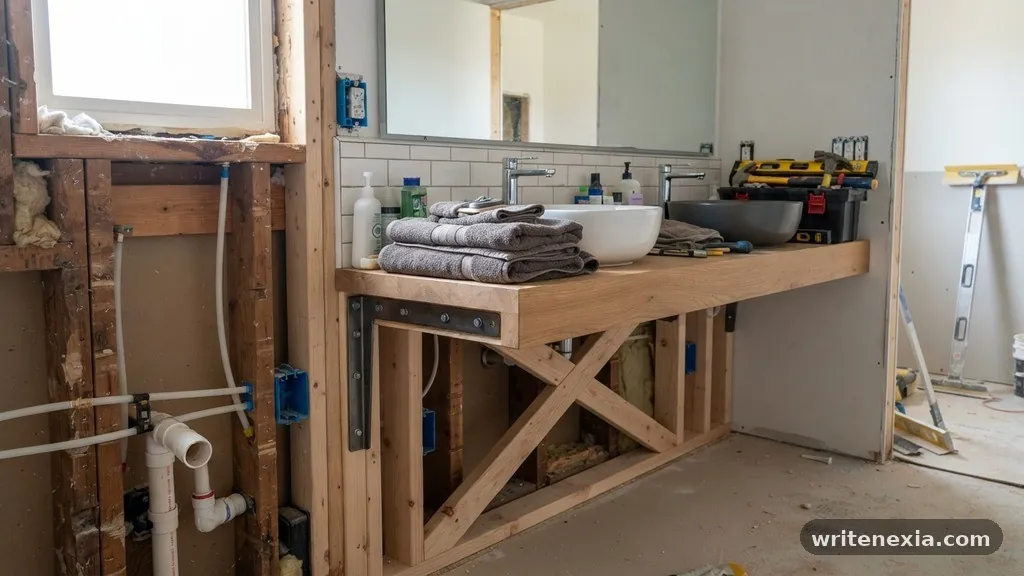
The foundation of any floating installation is the wall behind the vanity. In most modern home construction, walls are framed with 2×4 or 2×6 wooden studs spaced 16 inches on center. If your vanity is anchored directly into these studs using high-quality lag bolts, you gain a significant amount of leverage.
However, the connection point—where the vanity meets the wall—becomes the fulcrum. Any weight placed on the edge of the countertop creates a rotational force, known as torque, which attempts to pull the top of the vanity away from the wall.
If you are mounting a vanity to a wall that has been reinforced with a horizontal piece of blocking, your chances of success increase dramatically. Professional installers often open the wall cavity to install heavy-duty plywood blocking between the studs before finishing the drywall. Without this internal reinforcement, you are limited by the strength of the wood studs and the pull-out resistance of your fasteners.
If your wall is made of metal studs, the load capacity is drastically lower than that of wood-framed walls. Metal studs are thin and prone to deformation under the concentrated stress of a heavy vanity.
Material Weight and Structural Stress
Different countertop materials exert different levels of stress on a vanity unit. Granite and marble are exceptionally heavy, often weighing between 12 and 18 pounds per square foot depending on the thickness.
A standard 48-inch vanity top can easily weigh over 100 pounds before you even factor in the weight of a ceramic sink or a faucet. When you add water in the sink and the weight of someone leaning on the counter, the total load can quickly exceed 200 pounds.
Engineered stone, such as quartz, offers a slightly more uniform structure but carries similar weight characteristics to natural stone. Solid surface materials like Corian are lighter, but they can still flex over long, unsupported spans. Laminate is the lightest option, but it lacks the rigidity of stone and will bow or sag over time if it is not fully supported across its entire length.
When calculating how much weight can a floating vanity countertop support without brackets, you must account for the static load of the material itself. If the material is too heavy, the vanity cabinet will experience “creep,” a slow deformation that occurs under constant stress.
Why Brackets are Recommended
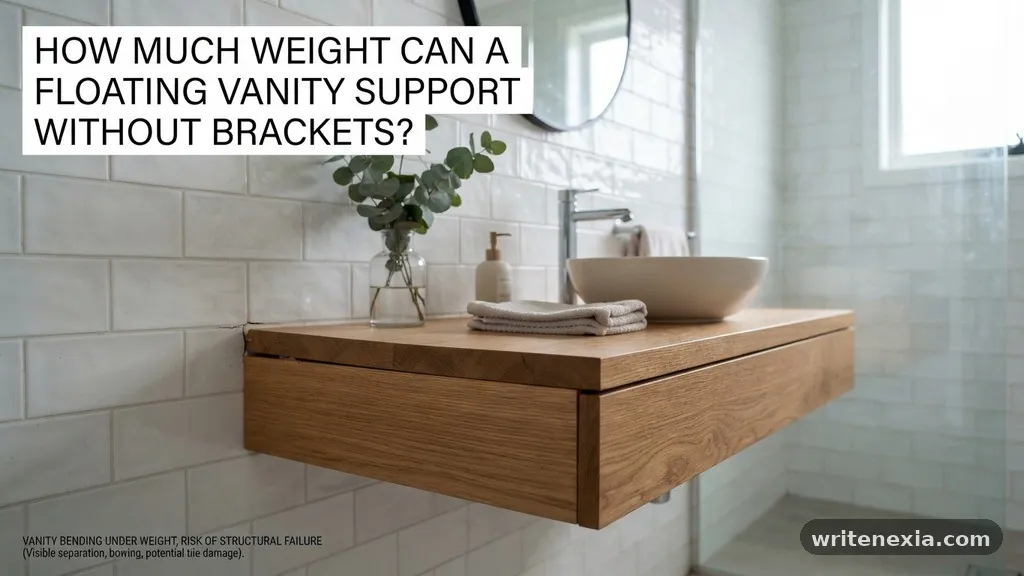
While the visual goal is a clean, bracket-free look, professional contractors almost always recommend internal support mechanisms. The term “without brackets” is often a misnomer; what people actually desire is “hidden support.”
This can be achieved through the use of heavy-duty steel plates that are routed into the top of the vanity or hidden within the wall structure. These plates provide the necessary rigidity to prevent the countertop from cracking at the sink cut-out, which is the most vulnerable point of any vanity top.
Without any form of support, the sink cut-out leaves only a few inches of material on the front and back edges. This narrow strip is extremely fragile. If someone leans on the front edge of the counter, the pressure is concentrated on this thin section of material.
Over time, hairline cracks will almost certainly develop at the corners of the sink opening. Using hidden steel supports distributes this weight across the entire wall structure, effectively turning the vanity into a floating shelf capable of supporting hundreds of pounds.
Comparing Load-Bearing Methods
To understand the difference in support, we can look at the common ways homeowners attempt to mount their vanities. The following table illustrates the typical weight capacities and reliability of different installation methods.
| Installation Method | Estimated Load Capacity | Structural Reliability |
|---|---|---|
| Direct to Drywall (No studs) | 0-10 lbs | High Failure Risk |
| Direct to Wood Studs (No brackets) | 20-40 lbs | Low (Sagging likely) |
| Hidden Steel Plate Supports | 200-400 lbs | High |
| Visible Decorative Brackets | 300-500+ lbs | Very High |
As shown in the table, attempting to support a heavy countertop without some form of structural reinforcement is rarely successful. Even if the unit stays on the wall, the vanity cabinet will likely pull away from the mounting surface. This results in a gap between the backsplash and the wall, which can lead to water infiltration and mold growth inside the wall cavity.
The Danger of Sink Cut-outs
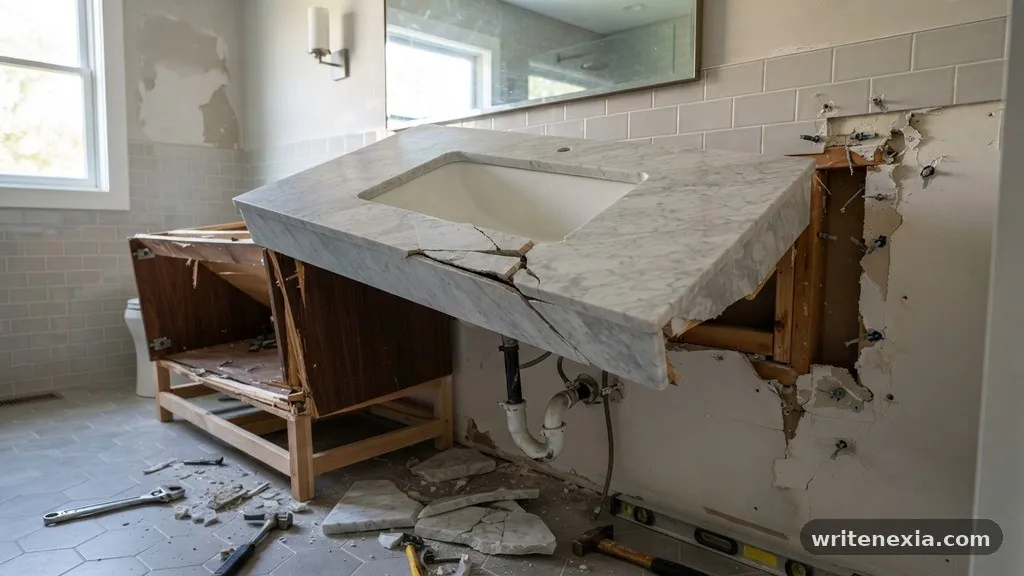
The sink cut-out is the primary reason why floating vanities fail. When you cut a large hole in the center of a countertop, you remove the material that provides the most structural stability. In a standard vanity, the weight is transferred down through the legs to the floor.
In a floating vanity, that path is broken. The weight of the sink, the faucet, and the plumbing must be transferred horizontally to the wall.
If you are using a heavy cast-iron or ceramic vessel sink, the weight is concentrated in the center of the span. Without support, the center of the vanity will sag. This sag is not always immediate.
It can happen over several months as the temperature and humidity levels in the bathroom fluctuate. Stone countertops are especially susceptible to this, as they have low tensile strength. They can snap cleanly in half if the support is uneven.
Leverage and Torque Principles
Physics dictates that the further the countertop extends from the wall, the greater the force on the fasteners. This is known as a lever arm.
A countertop that extends 20 inches from the wall creates significantly more torque than one that extends only 12 inches. If you are designing a custom floating vanity, keeping the depth to a minimum is a simple way to reduce the stress on your anchors.
Most standard bathroom vanities are 21 to 22 inches deep. This depth creates a substantial lever arm. If you are determined to avoid visible brackets, you must ensure that the internal frame of the vanity is constructed from structural-grade plywood or solid timber.
You should also use high-tensile-strength lag screws that penetrate at least 2.5 inches into the center of the wall studs. Never rely on wood screws, which have lower shear strength and are prone to snapping under sudden loads.
Common Materials and Their Limitations
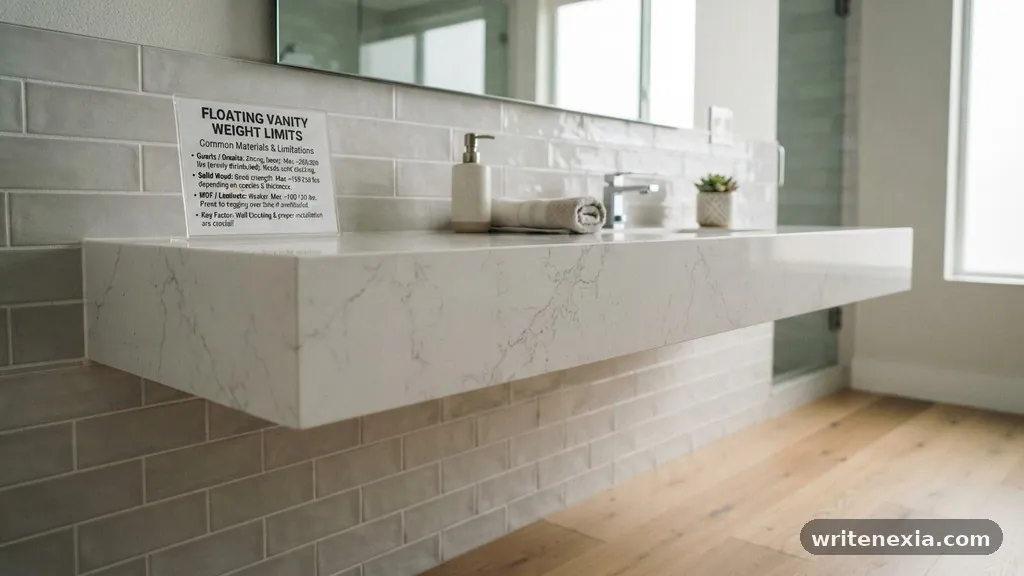
Not all materials perform equally when suspended. Granite is prone to invisible micro-fractures that can expand under stress.
Quartz is more flexible but can still crack if the support is uneven. Solid wood is perhaps the most forgiving material, as it can flex slightly without breaking, but it is prone to warping in the high-humidity environment of a bathroom.
If you choose a heavy material, you must be prepared to install reinforcement. If you choose a lighter material, you still need to ensure the vanity box itself is rigid. Many “floating” kits sold in big-box stores are made of medium-density fiberboard (MDF).
MDF is notorious for its poor fastener-holding capability. If you tighten a bolt into MDF, it can easily tear out, leading to a catastrophic failure of the entire unit. Always opt for solid wood or high-grade plywood cabinets if you are planning a floating installation.
Checklist for a Successful Installation
Before you finalize your design, review this list of requirements to ensure your vanity remains securely on the wall.
- Verify that your wall studs are made of solid wood and not metal or composite.
- Ensure your cabinet box is constructed from plywood or solid wood, avoiding MDF where possible.
- Install horizontal blocking between studs if your current wall layout does not align with the vanity mounting points.
- Use structural lag bolts or heavy-duty mounting hardware rather than standard wood screws.
- Incorporate hidden steel supports or L-brackets that are routed into the top of the vanity frame.
- Seal the gap between the vanity and the wall with high-quality, flexible silicone to prevent water damage.
- Test the installation with a static weight load equivalent to your expected daily use before finishing the plumbing.
Following these steps will prevent the most common causes of failure. While you might want to avoid visible hardware, never compromise on the structural integrity of the mounting system. Your safety and the longevity of your bathroom renovation depend on it.
Addressing Common Concerns
When planning a project of this nature, homeowners often have similar questions regarding the feasibility and safety of their designs.
Is it safe to lean on a floating vanity?
It is generally safe to lean on a floating vanity only if it has been installed with structural steel supports that are anchored directly to the wall studs. If the vanity is mounted only using the cabinet box, you should never put your full body weight on it, as the risk of the unit pulling away from the wall is significant.
How do I know if my wall studs can support the weight?
You can verify the strength of your wall by checking the condition of the wood. If the studs are dry, free of rot, and at least 3.5 inches thick (standard 2×4), they are typically sufficient to hold a standard vanity. If you see signs of water damage or if the studs are spaced wider than 16 inches, you should add additional blocking before proceeding.
Can I use adhesives instead of screws for a floating vanity?
Adhesives should never be used as the primary support for a floating vanity. While construction adhesive can help bridge small gaps and prevent movement, it cannot support the shear weight of a vanity, sink, and countertop. Always use mechanical fasteners as the primary means of support.
What is the most reliable way to hide support brackets?
The most reliable method is to use heavy-duty steel “T” or “L” brackets that are installed directly onto the wall studs before the drywall is finished. These brackets then sit hidden inside the vanity cabinet, providing a rigid platform for the countertop to rest upon while remaining completely invisible from the outside.
Does the weight of the sink affect the vanity’s stability?
Yes, the sink is one of the heaviest components of your vanity. A heavy stone or ceramic sink adds significant weight to the center of the span, which increases the pressure on the mounting points. Always ensure that the support system is designed to handle the combined weight of the countertop, the sink, and the fixtures.
Conclusion
Evaluating how much weight can a floating vanity countertop support without brackets reveals that the answer is rarely enough for a functional bathroom. While the sleek look of a floating unit is highly desirable, the physics of a cantilevered surface requires robust, hidden support. Relying solely on the cabinet box to hold the weight of heavy stone or composite materials is a recipe for structural failure and potential damage to your bathroom walls.
By incorporating hidden steel supports and ensuring your vanity is anchored securely to wall studs, you can achieve the aesthetic you want without sacrificing safety. Take the time to reinforce your wall blocking and choose high-quality materials to ensure your installation lasts for years. If you have questions about your specific wall type or countertop weight, consulting with a professional carpenter is always the best way to ensure your project is built to last.
Related Posts
What Is the Standard Front and Side Overhang for a Vanity Countertop?
-
Posted by
snighatfatima99@gmail.com
Best Heavy-Duty Steel Brackets for Supporting Granite Vanity Tops
-
Posted by
Scribing a Vanity Countertop to Fit Out-of-Square Alcove Drywall
-
Posted by
This place totally caught my attention from day one. The games load quickly and the graphics are top notch. I appreciate how they rotate their promotions so I never get bored. Support team is super helpful and responds within minutes. Definitely my favorite online setup right now. mm777slot